7 steps to building a trading strategy

7 steps to building a trading strategy

A trading strategy is a systematic methodology based on predefined rules and criteria that answers three major questions:

•What do you trade?
•Where do you trade?
•How do you trade?

How to build a trading strategy ?

When you start building your trading strategy, you can think of it as building a home:

•Psychology and discipline are the essential foundation.
•The walls of your building include a trading journal, market analysis, trading plan, and risk/money management.
•The strategy itself serves as the roof of the building. The final piece ties everything together and helps you trade confidently, knowing what you’re doing and why, without guessing.

Advantages of having a trading strategy

fbsA detailed strategy brings you one step closer to consistent results in trading.
fbsYou don’t need to ponder over every new trade, as you have predefined rules for entering and exiting a trade.
fbsYou use objective data to make specific decisions.
fbsYou avoid behavioral biases.

How to develop a trading strategy

fbsStart your trading journal and write everything down.
fbsDefine your trading goals and risk-to-reward ratio.
fbsChoose the instruments you want to trade.
fbsDecide what technical indicators and fundamental factors you will use.
fbsEstablish your timeframe.
fbsSet your risk management values.
fbsTrade with your strategy on a demo account and make amendments if necessary.

Now that you have built your strategy and tested it on your demo account, you can switch to your real trading account and start trading. Make sure you follow all your rules and review your results to ensure they meet your expectations and goals.

Most Trusted Broker — 2025

These awards confirm our commitment to building a rewarding trading environment and helping you uncover your potential. Thank you for choosing to trade with an award-winning broker!

Choose MetaTrader 5 with Top Forex Brokers?

•Blazing-fast execution & enhanced stability

•38 built-in technical indicators & 21 timeframes for precision trading

•Optimized for all devices—desktop, mobile & web

•Trade a wide range of assets: Stocks, Commodities, Forex & more!

Top Forex Brokers

https://www.topforexbrokerscomparison.com

True Chart patterns strategy for Technical Analysis

Chart patterns strategy

Chart patterns help traders predict market moves. Common chart patterns include head and shoulders, double tops, and flags.

fbsWhen you notice a pattern you are familiar with, you can be sure of the prediction’s accuracy.

How to use

1.Open a chart for a trading instrument you are interested in.
2.Identify a pattern on the chart (the strength of a reaction depends on the time frame you select).
3.Check the support and resistance levels to confirm the pattern.
4.Open your trade:

•Place a breakout trade for continuation patterns like flags or wedges.
•Use a retest trade for head and shoulders.

Place a Stop Loss above or below key levels to manage your risks.

Imbalance trading strategy

This strategy, also known as the “smart money strategy,” focuses on trading in key market zones called “imbalance zones.” These occur when prices move sharply in one direction on institutional orders (from banks and other huge players), leaving gaps in the chart.

How to use

1.Spot an imbalance. i.e. the area or gap between the price extremes of the first and third candles.
2.Wait for the price to return to that zone.
3.Open your trade:

Buy if the imbalance is below the current price.
Sell if the imbalance is above the current price.

Use the Fibonacci retracements to locate an optimal trade entry (OTE) point. Here is how:

1.Apply Fibonacci retracement from the recent high to low (or low to high).
2.Look for the 62—79% retracement zone as the OTE area.
3.Buy in an uptrend or sell in a downtrend near this zone.
4.Place a Stop Loss just above or below the recent swing.
5.Aim for at least a 1:2 risk-to-reward ratio.

Moving average strategy

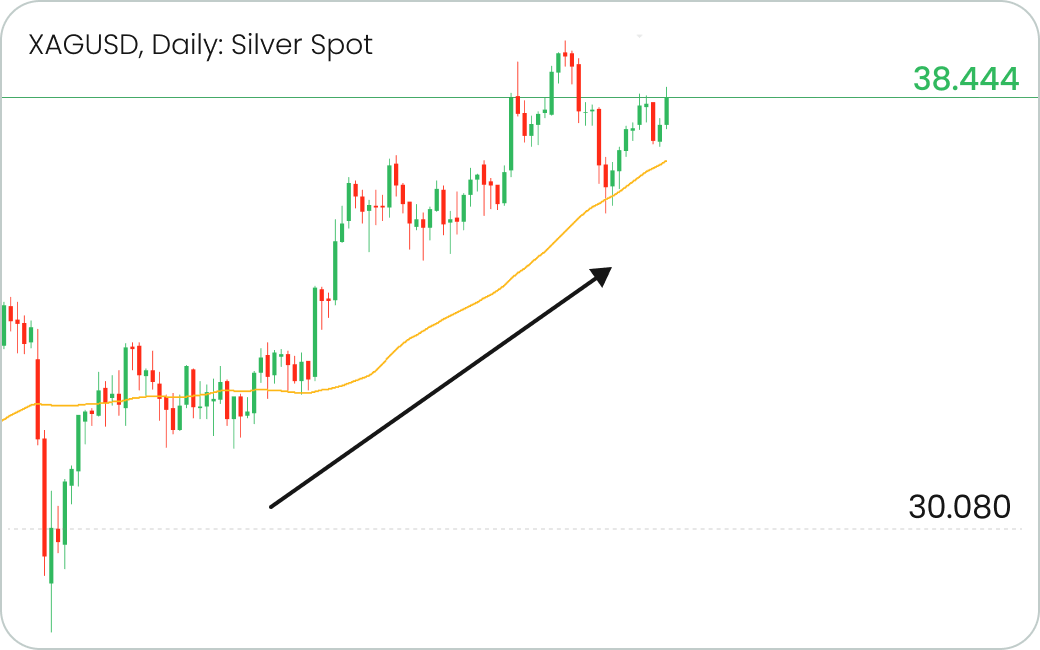
A moving average takes average price values and smoothes out data to highlight trend directions and essential support or resistance areas. Traders love this indicator for its simplicity and reliability. Implementing this strategy, you can confidently follow an existing trend.

How to use

1.Add two moving averages to your chart:
•50-day MA for short-term trends
•200-day MA for long-term trends

2.Open your trade according to the signals:

•Buy when the 50-day MA crosses the 200-day MA going up (a golden cross).
•Sell when the 50-day MA crosses the 200-day MA, moving down (death cross).

Apply this strategy to higher timeframes to improve reliability.

Most Trusted Broker — 2025

These awards confirm our commitment to building a rewarding trading environment and helping you uncover your potential. Thank you for choosing to trade with an award-winning broker!

Choose MetaTrader 5 with Top Forex Brokers?

•Blazing-fast execution & enhanced stability

•38 built-in technical indicators & 21 timeframes for precision trading

•Optimized for all devices—desktop, mobile & web

•Trade a wide range of assets: Stocks, Commodities, Forex & more!

Top Forex Brokers

https://www.topforexbrokerscomparison.com

How charts can help you identify trends and predict trades in forex, stocks, and commodities

How charts can help you identify trends and predict trades in forex, stocks, and commodities

A chart pattern is a sequence of price movements repeating over time. Such a sequence lets you guess the following price movements if the sequence repeats. Chart patterns are an essential element of the technical analysis toolkit.

Chart patterns help you:

•Identify market trends.
•Predict market movements and open your positions with confidence.
•Analyze different markets, including Forex, stocks, commodities, etc.

Ascending and descending staircases

An ascending staircase pattern is a classic example of a bull market. When you notice this pattern, you might open long positions and enjoy the ride up until the trend shifts.

The dips here can be an excellent opportunity to buy in at a better price before the market pushes higher again.

Conversely, a descending staircase pattern indicates a market on the decline.

If you spot this downward trend, you might look for chances to sell and use brief upswings against the bear trend to enter short positions.

Ascending and descending triangles

An ascending triangle forms when an asset’s highs stay roughly the same while the lows gradually rise. This pattern usually signals that the market might keep moving up. The market tends to consolidate, but if the price moves past the resistance level, a new upward trend will follow.

You should double-check this pattern using volume indicators. If volume surges when the breakout happens, that’s a good sign the price will continue to rise. However, if the price falls under the support level or if volume drops, this might signal a downtrend begins.

A descending triangle usually signals that the market might break through the support level and keep falling, so it’s generally a bearish sign. However, if the market manages to break through the resistance level, it could indicate the start of an uptrend.

Flags

A flag pattern demonstrates a market’s pause before it makes its next big move. In a bullish flag, the lines slope downward, and when the price breaches the resistance level, it points to the start of a fresh upward trend. On the flip side, a bearish flag has lines sloping upward, and a drop below the support level means a new downtrend might be beginning.

Flags often appear after strong trends: bullish flags after an uptrend and bearish flags after a downtrend.

Wedges

A wedge pattern is similar to a flag, but the lines gradually converge instead of staying parallel. A drop in trading volume suggests we can anticipate a big move.

When you see a rising wedge, the market usually breaks down through support by the end of the pattern. This could be a sign for you to open a bearish trade or wrap up a long position.

Head and shoulders

A classic chart formation with a central peak (the head) and two shorter peaks known as the shoulders. All three peaks tend to align with a support level called the neckline.

The head and shoulders pattern suggests that bullish momentum is fading. The market tried to push higher twice but failed on the third attempt, which hints that it’s time for a downward move.

Most Trusted Broker — Asia 2024
Broker of the Year — LATAM 2024

https://www.topforexbrokerscomparison.com

These awards confirm our commitment to building a rewarding trading environment and helping you uncover your potential. Thank you for choosing to trade with an award-winning broker!

Mastering the ICT Trading Strategy: Key Techniques

Mastering the ICT Trading Strategy: Key Techniques

In today’s rapidly evolving global economy, Information and Communication Technology (ICT) has become a cornerstone for innovation and growth across various sectors. The ICT sector itself presents numerous opportunities for trading and investment, driven by technological advancements and increasing demand for digital solutions. However, mastering the ICT trading strategy requires a deep understanding of market dynamics, technological trends, and strategic approaches to capitalizing on opportunities while mitigating risks.

Free Forex Signals

Understanding the ICT Sector

The ICT sector encompasses a broad range of products and services, including software development, hardware manufacturing, telecommunications, internet services, and digital content creation. Each sub-sector within ICT is characterized by its unique set of challenges and opportunities, requiring traders to adopt specialized strategies tailored to the specific dynamics of these markets.

Key Techniques for Success

To excel in ICT trading, one must adopt a multifaceted approach that leverages both quantitative analysis and qualitative insights. Here are some key techniques:

1. Market Analysis
  • Trends and Forecasting: Stay abreast of emerging technologies and industry trends through continuous research and analysis. Utilize forecasting models to predict future market movements.
  • Macroeconomic Indicators: Understand how broader economic factors can influence the ICT sector, such as changes in interest rates, inflation, and regulatory policies.
2. Technological Insights
  • Innovation Cycles: Recognize the cyclical nature of technological innovation and adapt strategies accordingly. Identify companies that are leaders in research and development (R&D).
  • Disruption: Be aware of disruptive technologies that could alter the competitive landscape, such as artificial intelligence, blockchain, and quantum computing.
3. Financial Metrics
  • Valuation Models: Apply appropriate valuation models to assess the intrinsic value of ICT companies. Common models include discounted cash flow (DCF), price-to-earnings (P/E) ratio, and enterprise value-to-revenue (EV/Revenue).
  • Profitability Ratios: Analyze key financial ratios like return on equity (ROE), return on assets (ROA), and operating margin to gauge profitability and efficiency.
4. Risk Management
  • Diversification: Implement diversification strategies to spread risk across different segments of the ICT sector and geographic regions.
  • Hedging: Use hedging techniques, such as options and futures contracts, to protect against adverse market movements.
5. Strategic Investment
  • Long-term Vision: Adopt a long-term perspective when investing in ICT, focusing on sustainable growth rather than short-term gains.
  • Partnerships and Acquisitions: Consider the strategic value of partnerships and acquisitions that can enhance a company’s competitive position or expand its market reach.

If you wish to get the latest forex brokers, you can visit our Top Forex Brokers official website:

https://www.topforexbrokerscomparison.com

Mastering the ICT trading strategy involves a combination of technical knowledge, market insight, and strategic planning. By staying informed about industry trends, employing robust analytical tools, and implementing effective risk management practices, investors can navigate the complexities of the ICT sector and capitalize on its potential for growth and innovation. As technology continues to evolve at an unprecedented pace, those who can adapt their strategies will be best positioned to succeed in this dynamic field.

How Can You Use GDP? What Is GDP? Important Economic Figures for Investors

How Can You Use GDP? What Is GDP? Important Economic Figures for Investors

Gross Domestic Product (GDP) is a critical economic indicator that measures the total value of all final goods and services produced within a country’s borders over a specific time period, usually a year or quarter. It serves as a fundamental gauge of a nation’s economic health and is widely used by investors, economists, and policymakers to make informed decisions. Understanding how to interpret GDP data can provide valuable insights into the economic landscape, which is essential for investors looking to capitalize on market trends.

Free Forex Signals

What Is GDP?

GDP is calculated by summing up the monetary value of every good and service produced in a country during a specified time frame. There are three main methods to calculate GDP:

  1. Expenditure Approach: This method sums up all expenditures made by households, businesses, government, and net exports.
  2. Income Approach: This method calculates GDP by adding up all income earned from producing domestic goods and services, including wages, rents, interest, and profits.
  3. Value-Added Approach: Also known as the production approach, this method involves adding up the value added at each stage of production.

How Can You Use GDP?

Investors can leverage GDP data in several ways:

  1. Economic Health Indicator: A growing GDP suggests a healthy economy, while a declining GDP might indicate recessionary pressures. Investors can use this information to anticipate changes in consumer spending, corporate earnings, and employment rates, which could influence investment strategies.
  2. Market Trends Analysis: By tracking GDP growth rates, investors can identify potential shifts in market trends. For example, strong GDP growth might correlate with rising stock prices, whereas negative GDP growth could signal a downturn in the markets.
  3. Policy Expectations: GDP figures can inform expectations about future monetary policies. If GDP growth is sluggish, central banks might lower interest rates to stimulate economic activity, which could impact bond yields and currency values.
  4. Comparative Analysis: Comparing GDP figures across different countries can help investors understand relative economic performance and potentially identify undervalued investment opportunities.
  5. Sectoral Insights: GDP data broken down by sector can reveal which parts of the economy are expanding or contracting. Investors can use this granularity to focus their investments in growing sectors or avoid those in decline.

Important Economic Figures for Investors

While GDP is a cornerstone metric, it is just one piece of the puzzle. Other key economic indicators that investors should monitor include:

  • Inflation Rates: Measured by indices such as the Consumer Price Index (CPI), inflation impacts purchasing power and interest rates.
  • Employment Data: Unemployment rates and job creation numbers reflect the health of labor markets and consumer confidence.
  • Interest Rates: Central bank policies affecting borrowing costs can influence stock valuations and capital flows.
  • Retail Sales: Indicate consumer spending levels, which drive a significant portion of economic activity.
  • Housing Starts and Building Permits: Reflect confidence in the real estate sector and broader economic conditions.

If you wish to get the latest forex brokers, you can visit our Top Forex Brokers official website:

https://www.topforexbrokerscomparison.com

Understanding GDP and its implications is crucial for investors seeking to navigate the complexities of global financial markets. By integrating GDP data with other economic indicators, investors can gain a comprehensive view of economic trends, helping them make more informed decisions and potentially improve their investment outcomes.

Top Forex Trading Robots of 2024

Top Forex Trading Robots of 2024

The foreign exchange market, commonly known as Forex or FX, is one of the most liquid financial markets globally. With trillions of dollars traded every day, it’s no surprise that technology has taken center stage in facilitating trades and enhancing profitability. Automated trading systems, also known as Forex robots or EAs (Expert Advisors), have become increasingly popular among traders of all levels, from beginners to seasoned professionals. Here we present a list of some of the top Forex trading robots available today.

1. MetaTrader 4 (MT4) Expert Advisors

MetaTrader 4 remains one of the most widely used platforms in the Forex industry. Its robust infrastructure supports custom programming through MQL4, enabling users to create their own automated trading strategies. MT4’s Expert Advisors can execute trades automatically based on predefined rules, providing traders with a powerful tool to enhance their trading experience.

2. Cryptohopper

Primarily designed for cryptocurrency trading, Cryptohopper has expanded its capabilities to include traditional currency pairs as well. With a user-friendly interface and support for multiple exchanges, this robot allows traders to automate their trading strategies across different markets. It offers advanced features such as social trading, where users can copy the trades of successful traders.

3. OANDA Automated Trading Systems

OANDA, a well-known name in the Forex industry, offers an API that enables developers to build custom trading solutions. The OANDA API can be used to create automated trading systems that interact with the market in real-time. This flexibility makes it a preferred choice for those who wish to implement sophisticated algorithms.

4. PostBank’s “邮小助” (Yóu Xiǎo Zhù)

In the realm of institutional trading, China’s Postal Savings Bank has introduced “邮小助,” an AI-powered trading assistant specifically designed for the domestic currency market. Leveraging the China Foreign Exchange Trade System (CFETS) iDeal platform, this robot facilitates intelligent online inquiries and responses for repurchase agreement transactions, streamlining the process for financial institutions.

5. Industrial and Commercial Bank of China’s AI Trading Robot

The Industrial and Commercial Bank of China (ICBC) has also ventured into AI-driven trading with its own AI trading robot. This system integrates machine learning and natural language processing technologies to perform functions like trade inquiry, risk management, and data analysis, enhancing efficiency within the bank’s operations.

6. OTFX’s AI-Powered Trading Solutions

OTFX offers innovative trading solutions by integrating AI and machine learning techniques into its systems. These advancements allow for more precise market data analysis, providing investors with tailored advice and improved risk management tools.

If you wish to get the latest forex brokers news,you can visit our Top Forex Brokers official website:

https://www.topforexbrokerscomparison.com

Each of these robots brings unique features to the table, catering to diverse needs within the Forex community. Whether you’re looking for speed, customization, or advanced analytics, there’s a trading robot that can fit your requirements. As the technology evolves, these systems continue to adapt, offering traders new ways to engage with the market effectively.

Swimming with Turtles: Lessons from a Legendary Trading System

Unleashing the Power of Persistence: The Turtle Trading System Explained

In the world of trading, few systems have achieved the legendary status of the Turtle Trading System. Born out of a famous experiment conducted by commodities trader Richard Dennis in the 1980s, this method has since become a cornerstone of trend-following strategies. Let’s delve into the principles behind the Turtle Trading System and why it remains relevant for modern traders.

Origins of the Turtle Trading System

In 1983, Richard Dennis and Bill Eckhardt made a bet regarding the nature of successful trading. Dennis believed that he could teach anyone his trading principles and turn them into successful traders. To test this hypothesis, he recruited a group of individuals with diverse backgrounds and trained them in his methods. These trainees were dubbed “Turtles” because Dennis joked that he could turn even turtles into traders.

Over the next few years, the Turtles achieved remarkable success, generating impressive returns in various markets. Their methods were eventually published and have since been adopted by traders around the globe.

Core Principles of the Turtle Trading System

The Turtle Trading System is built upon several key principles that emphasize disciplined trading practices and a focus on long-term trends.

Entry Rules

  • Breakout Method: Turtles used a simple breakout strategy to enter trades. For buying, they would enter long positions when the price exceeded a specific high over a defined period (e.g., 20 days). For selling short, they would enter when the price fell below a specific low over the same period.

Risk Management

  • Position Sizing: To control risk, Turtles adhered to strict position sizing rules. They calculated the number of contracts or lots based on the size of their account and the volatility of the instrument being traded.
  • Stop Losses: Protective stop losses were set at predetermined levels to minimize losses if the trade moved against them.

Exit Strategies

  • Profit Targets: For exits, Turtles used trailing stops that would lock in profits if the market continued to move in their favor. They also had fixed profit targets that varied depending on the strength of the trend.

Why It Works

The success of the Turtle Trading System can be attributed to its adherence to systematic trading rules and disciplined approach to managing risk. By focusing on capturing large moves in the market rather than trying to predict every twist and turn, Turtles were able to achieve consistent results over time.

Modern Applications

While the original Turtle Trading System was developed decades ago, its core concepts remain relevant today. Many traders continue to apply these principles in contemporary markets, adapting them to current trading technologies and market dynamics.

If you wish to get the latest forex brokers news,you can visit our Top Forex Brokers official website:

https://www.topforexbrokerscomparison.com

The Turtle Trading System exemplifies the power of systematic trading and disciplined risk management. Its enduring legacy is a testament to the fact that, in trading, consistency and adherence to a well-defined strategy can lead to long-term success. Whether you’re a novice trader looking to establish a solid foundation or an experienced trader seeking to refine your approach, the principles of the Turtle Trading System offer valuable insights into achieving sustainable profitability in the markets.

Top 5 Forex Trading EAs: Automation for the Modern Trader

Top Forex Trading EAs: Automate Your Way to Success

In the realm of automated trading within the foreign exchange market, Expert Advisors (EAs) have become increasingly popular among traders looking to leverage technology to optimize their trading strategies. Forex EAs are software programs that automate trading decisions and can execute trades on behalf of the user. They operate within trading platforms like MetaTrader 4 or 5 and follow predefined rules for entering and exiting trades. Here’s a list of some of the most reputable and effective Forex EAs available today:

1. Trend Following EA

Description: Trend Following EAs identify trends in the market and attempt to capitalize on them by opening positions in the direction of the trend. These systems often use moving averages and other trend indicators to detect momentum shifts.

Pros: Can be highly profitable if the market is trending strongly.

Cons: May suffer drawdowns during sideways markets or when trends reverse suddenly.

2. News-Based EA

Description: News-based EAs are designed to react to economic news releases that can cause volatility in the markets. These systems typically place trades immediately after news events, aiming to capture short-term price movements.

Pros: Potentially high returns during significant news releases.

Cons: High risk due to unpredictable market reactions to news events.

3. Scalping EA

Description: Scalping EAs focus on making small profits from numerous trades over a short period. They exploit minor price changes and aim to capitalize on slight movements in the market.

Pros: Can generate frequent profits if the market has sufficient liquidity.

Cons: Requires very tight stop-losses and may incur high transaction costs.

4. Arbitrage EA

Description: Arbitrage EAs take advantage of discrepancies in prices of the same asset across different markets. They simultaneously buy and sell these assets to profit from the price differences.

Pros: Low risk and can produce steady returns if arbitrage opportunities exist.

Cons: Opportunities are rare and often short-lived, requiring fast execution speeds.

5. Machine Learning EA

Description: Machine learning EAs use advanced algorithms to learn from historical data and adapt their trading strategies over time. They aim to improve performance by continuously refining their predictive models.

Pros: Ability to adapt to changing market conditions and potentially improve over time.

Cons: Requires substantial computational resources and expertise to develop and maintain.

If you wish to get the latest forex brokers news,you can visit our Top Forex Brokers official website:

https://www.topforexbrokerscomparison.com

Selecting the right Expert Advisor depends on various factors, including your trading preferences, risk tolerance, and the specific market conditions you aim to exploit. While automation can streamline trading processes and potentially increase profitability, it’s crucial to understand the underlying mechanics of these systems and to carefully manage risks. Before committing to an EA, it’s advisable to conduct thorough research, backtest the system, and perhaps start with a demo account to see how it performs under real market conditions.

Invest Forex Markets with the Best Forex Trading Systems

Finding the Perfect Forex Trading System

In the vast and dynamic world of foreign exchange (Forex) trading, having the right tools can make all the difference between success and failure. The best Forex trading systems are those that not only help traders navigate the complexities of currency markets but also enhance their decision-making process. We will explore what constitutes a top-tier Forex trading system and provide insights into choosing one that suits individual needs.

Understanding Forex Trading Systems

A Forex trading system is a set of rules or guidelines that dictate when to enter or exit a trade. These systems can be manual, involving human decision-making, or automated, using software algorithms to execute trades based on predefined parameters. The primary goal of any Forex trading system is to generate consistent profits by identifying profitable trading opportunities.

Key Components of Effective Forex Trading Systems

Market Analysis Tools

Effective trading systems incorporate sophisticated tools for market analysis. These may include technical indicators such as Moving Averages, Relative Strength Index (RSI), and Bollinger Bands, which help in predicting future price movements based on historical data.

Risk Management Features

Risk management is paramount in Forex trading. The best systems incorporate features like stop-loss orders and position sizing strategies to limit potential losses while maximizing gains.

Backtesting Capabilities

Backtesting involves simulating historical market data through a trading system to evaluate its performance under real-world conditions without risking capital. This process is crucial for validating the effectiveness of a trading strategy before deploying it in live markets.

Types of Forex Trading Systems

Manual Trading Systems

These systems rely on traders’ discretion to interpret market signals and execute trades accordingly. They are suitable for traders who prefer hands-on involvement and have a good understanding of technical and fundamental analysis.

Automated Trading Systems

Automated systems use pre-programmed software to execute trades based on specific criteria without human intervention. They are ideal for traders looking to implement complex strategies consistently and without emotional bias.

Selecting the Right Forex Trading System

When choosing a Forex trading system, consider the following factors:

  • Experience Level: Beginners might benefit more from simpler systems with educational resources, whereas experienced traders might prefer advanced platforms with customizable features.
  • Trading Style: Scalpers, day traders, and swing traders each require different types of systems tailored to their specific timeframes and risk profiles.
  • Market Conditions: Some systems perform better during volatile periods, while others are designed for more stable markets.

If you wish to get the latest forex brokers news,you can visit our Top Forex Brokers official website:

https://www.topforexbrokerscomparison.com

The “best” Forex trading system varies depending on individual trader needs, experience, and objectives. What works for one trader may not work for another. Therefore, it’s essential to thoroughly research and test different systems to find the one that aligns with your trading style and goals. Whether manual or automated, the key lies in selecting a system that provides reliable signals, incorporates robust risk management, and can be effectively backtested to ensure its viability in real trading scenarios.


When and How to Enter the Forex Markets ?

When and How to Enter the Forex Markets: A Comprehensive Guide

How-to-Choose-the-Best-Forex-Brokers

Entering the forex (foreign exchange) market can be both exciting and challenging. Knowing when and how to enter the market can significantly impact your trading success. This guide will provide you with a comprehensive understanding of the best times to enter the forex markets and the strategies to employ for effective entry points.

Table of Contents

  1. Understanding Market Timing
  2. Identifying Entry Points
  3. Strategies for Entering the Forex Markets
  4. Risk Management and Position Sizing

1. Understanding Market Timing

Market timing in forex trading refers to the practice of entering and exiting trades based on the timing of market movements. Successful market timing requires a deep understanding of market cycles, economic indicators, and the psychology of traders.

  • Market Cycles: Forex markets typically move in cycles, transitioning between periods of high volatility and low volatility. Understanding these cycles can help you determine the best time to enter the market.
  • Economic Indicators: Economic data releases, such as GDP, employment figures, and inflation rates, can significantly impact forex market movements. Paying attention to these indicators can help you anticipate market reactions and plan your entries accordingly.
  • Psychology of Traders: Market psychology plays a crucial role in determining market movements. Fear and greed often drive market participants, and understanding these emotions can give you an edge in timing your entries.

2. Identifying Entry Points

Entry points are specific price levels or market conditions that suggest a high probability of a profitable trade. Here are some common methods for identifying good entry points:

  • Technical Analysis: Tools such as moving averages, support and resistance levels, and candlestick patterns can provide clear signals for entry.
  • Fundamental Analysis: News events, central bank announcements, and economic data releases can create opportunities for strategic entries.
  • Volatility Breakouts: High volatility periods can indicate significant price movements, providing ideal entry points.

3. Strategies for Entering the Forex Markets

Different strategies can be employed depending on your trading style and objectives:

  • Trend Following: This strategy involves entering the market in the direction of the prevailing trend. Key indicators include moving averages and trend lines.
  • Counter-Trend: This approach involves trading against the prevailing trend, often after a significant move. It requires careful risk management and a clear exit strategy.
  • Breakout Trading: Breakouts occur when the price moves beyond a key level of support or resistance. Trading breakouts requires patience and confirmation of the breakout.
  • News Trading: This strategy involves entering trades immediately before or after significant news events, capitalizing on the immediate market reaction.

4. Risk Management and Position Sizing

Effective risk management is crucial for long-term success in forex trading. Here are some key principles:

  • Stop Losses: Set stop-loss orders to limit potential losses on any given trade. Adjust them based on the volatility of the currency pair.
  • Position Sizing: Determine the size of your position based on your account size and the risk you are willing to take. Typically, risk no more than 1-2% of your account on any single trade.
  • Diversification: Spread your risk across different currency pairs and markets to reduce exposure to any single event or market.

Entering the forex markets at the right time and with the right strategy can significantly enhance your trading results. By understanding market timing, identifying clear entry points, employing effective strategies, and managing risk properly, you can improve your chances of success in the forex markets.

Remember, trading is a continuous learning process, and staying adaptable to changing market conditions is key to long-term profitability.

If you wish to get the latest forex brokers news,you can visit our Top Forex Brokers official website:

https://www.topforexbrokerscomparison.com